Labels

Showing posts with label Film Review. Show all posts

Thursday, 10 May 2018

Film Review | Ethel and Ernest


Ethel and Ernest (2016) was directed by Roger Mainwood and based on the story by Raymond Briggs. The film tells the story of Raymond Briggs parents from the 1920's, when they married, through to the 1970's.

Movie poster

The film carefully preserves the art style of Raymond Brigg's. This 'fidelity to Briggs’ illustrative aesthetic is welcome, as it maintains a homey, appropriately somewhat retro air redolent of pencil sketches and pastels.' (Harvey, 2017). This can be seen even in the movie poster when looked at alongside the book cover as they have managed to capture some of the qualities of Brigg's artsyle without stopping the film from looking 3D. The film was created entirely digitally, unlike previous adaptations of Brigg's work, however the feeling of pencil on paper was kept intact. The effect of this is a sense of nostalgia that runs through the film both due to the art style and the subject of the film.

Image result for raymond briggs
Book cover

The film tells the story of an ordinary couple and is ' a tender story about the lost world of what we now call the “white working class”'. (Bradshaw, 2016). Though because of that 'Ethel & Ernest proves to be a quietly moving tribute to a real-life couple who are extraordinary precisely because of their very ordinary life.' (Smith, 2016). The interest in this story lies not in the tale itself but in the way it's told and the viewers ability to relate to the contents and characters within.

Bibliography:

- Bradshaw, P, (2016), Ethel & Ernest review – moving adaptation of Raymond Briggs's graphic novel, https://www.theguardian.com/film/2016/oct/27/ethel-ernest-review-moving-adaptation-of-raymond-briggss-graphic-novel

- Harvey, D, (2017), 'Film Review: Ethel & Ernest', http://variety.com/2017/film/reviews/ethel-and-ernest-review-1202643201/

- Smith, A, (2016), Ethel and Ernest Review, https://www.empireonline.com/movies/ethel-ernest/review/

Image List:

- Image 1, Movie Poster, Found At: https://viewsfromthesofa.com/2017/01/03/ethel-and-ernest-2016-review/

- Image 2, Book Cover, Found At: https://www.penguin.co.uk/authors/raymond-briggs/17111/

Friday, 2 March 2018

Film Review | Waltz with Bashir

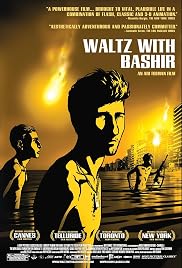
Waltz with Bashir (2008) was directed by Ari Folman. It tells the story of Folmans experience in the Lebanon war through the film by showing him searching for his memories of the war.

Fig 1, Movie Poster.
The film uses an art style based on that of comic books to show the search for memorias. The use of animation in the film works 'as the best way to reconstruct memories, fantasies, hallucinations, possibilities, past and present.' (Ebert, 2009). This is because it gives a sense of something not being real as well as allowing for the distortion usually seen in films. Thus the 'freedom of animation allows him to visualize what they tell him -- even their nightmares.' (Ebert, 2009).

Related image
Fig 2, Ari's Memory
The film is a retelling of memories of the event and thus doesn't 'claim to be an accurate historical account of the 1982 Israeli invasion of Lebanon, and is most certainly nothing of the kind. Instead, it presents itself as a psychodrama focusing on the long-term traumatic effects on some individual Israeli soldiers' (Ibish, 2009). This is shown in the focus it gives on the importance of Ari remembering the invasion and in the expressions and feelings of the soldiers he talks to. This allows for the film to look at the way people were effected by the events and a more personal view instead of just retelling them factually.

Image result for waltz with bashir
Fig 3, Remembering
The film's focus on the individual emotions of the soldiers is important. One reason for this is  'Since the vast majority of young Israelis serve in the army and many face disturbing episodes or encounters, the film has opened a rare conversation here about the impact of those experiences.' (Bronner, 2008).


Bibliography:

- Bronner, E, (2008), In Search of the Soldier in His Past, http://www.nytimes.com/2008/12/14/movies/14bron.html (Accessed on: 15/02/18)

- Ebert, R, (2009), Waltz with Bashir, https://www.rogerebert.com/reviews/waltz-with-bashir-2009 (Accessed on: 15/02/18)

- Ibish, H, (2009), A Waltz with the Dogs of Memory,https://www.thenation.com/article/waltz-dogs-memory/

Image List:

- Fig 1, Movie Poster, Found At: http://www.imdb.com/title/tt1185616/

- Fig 2, Ari's Memory, Found At: https://oneroomwithaview.com/2015/03/13/cel-mates-waltz-bashir/

- Fig 3, Remembering, Found At: https://www.documentary.org/magazine/waltz-bashir-fallibility-yet-persistence-memory

Thursday, 15 February 2018

Film Review | Belleville Rendez-Vouz

Belleville Rendez-Vouz (2003) is a French film directed by Sylvain Chomet. The film Belleville Rendez-Vous is also known under the name The Triplets of Belleville and tells the story of a boy who wants to take part in the Tour de France and is living with his grandma.

Fig 1, Movie Poster

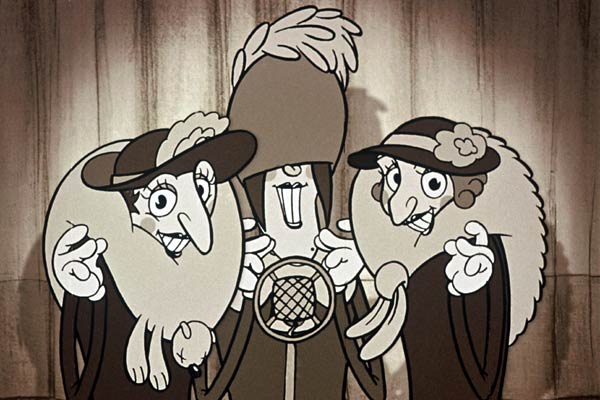
The film begins with a scene of the triplets mid performance. This is all done with rubber-hose animation as the style in reference to the animation used in the time period portrayed. After the opening scene the film continues in a more modern animation style so as to represent the way the show they were watching came from a past time.

Related image
Fig 2, The triplets in Rubber-Hose style
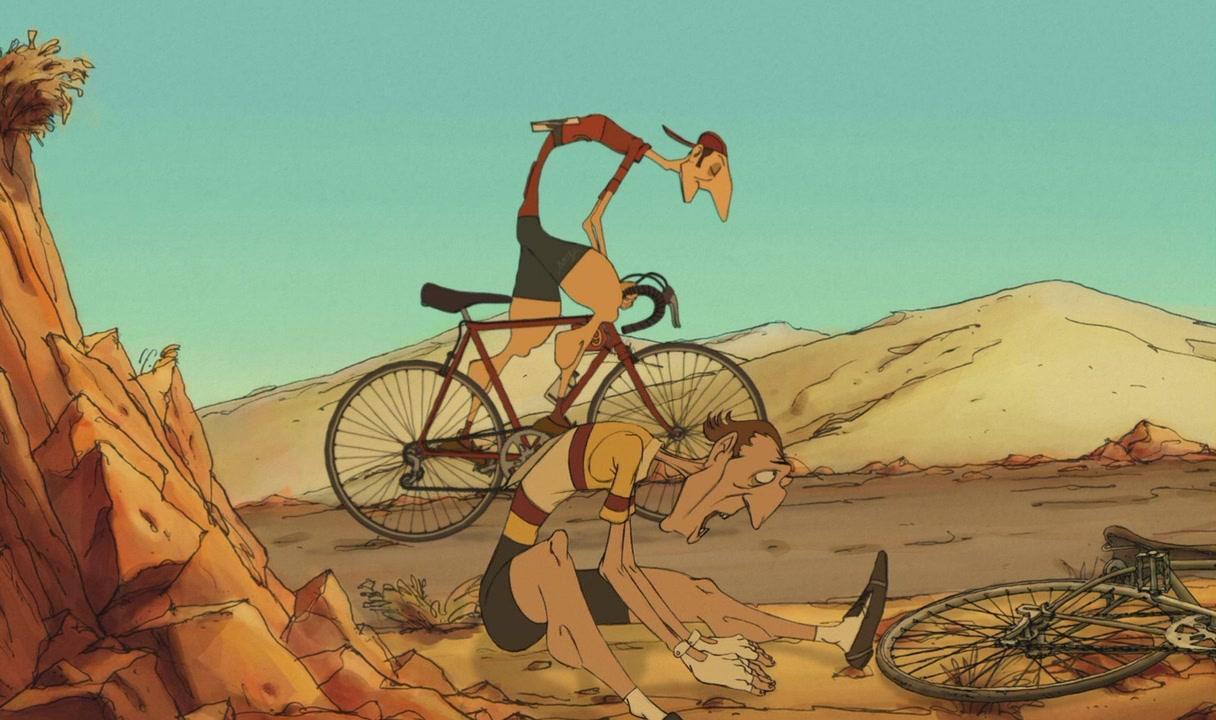
Throughout the film there is little to no dialogue and so the film uses it's art style to convey things. This is done through the use of 'a deliberately antiquated visual style, and Chomet relishes caricaturing the body shapes of his characters - whether it's the overly muscular thighs and protuberant nose of Champion, or the grotesquely obese residents of Belleville.' (Dawson, 2003). The use of exaggeration on the characters allows the audience to understand the characters personalities. An example of this is the way the sons legs are exaggerated to show that he is a cyclist.

Fig 3, The cyclists.

During the film the son gets kidnapped from the race and his grandmother then sets out to save him. This leads the grandmother 'to Belleville, a Manhattan-like dream city populated by obese hamburger eaters, cretinous Boy Scouts, and a diminutive red-nosed French mafia chieftain.' (Scott, 2003). This is the start of a 'world of selfishness, cruelty, corruption and futility -- but it's not serious about this world and it doesn't want to attack it or improve upon it. It simply wants to sweep us up in its dark comic vision.' (Ebert, 2003). Though the film is including a kidnapping that leads to a character being caught in a torture like gambling ring it never loses it's sense of fun.

Bibliography:

- Dawson, T, (2003), Belleville Rendez-Vouz, http://www.bbc.co.uk/films/2003/08/06/belleville_rendezvous_2003_review.shtml (Accessed on: 15/02/18)

- Ebert, R, (2003), The Triplets of Belleville, https://www.rogerebert.com/reviews/the-triplets-of-belleville-2003 (Accessed on: 15/02/18)

- Scott, A, (2003), Nostalgia For a Land That Twirls In Dreams:
 http://www.nytimes.com/movie/review?res=9E04E1DA1F3BF935A15752C1A9659C8B63 (Accessed on: 15/02/18)

Illustration List:

- Fig 1, Movie Poster: https://www.amazon.co.uk/Belleville-Rendez-vous-DVD-Mich%C3%A8le-Caucheteux/dp/B015ZGAT7C

- Fig 2, The triplets in Rubber-Hose Style: http://www.allocine.fr/film/fichefilm-44206/photos/detail/?cmediafile=18354168

- Fig 3, The cyclists: https://www.silent-frame.com/articles/2003-belleville-rendezvous-sylvain-chomet

Tuesday, 6 February 2018

Film Review | Paprika

Paprika (2006) is a Japanese film directed by Satoshi Kon. It was based on Yasutaka Tsutsui's novel from 1993.

Image result for paprika 2006
Fig. 1, Movie Poster
In the film there is a device, called the DC Mini, that allows the wearer, usually a therapist, to enter the dreams of their patient so they can help to treat them more efficiently. Through the film we follow a therapist called Paprika as she helps people through dreams while the DC Mini's creators search for a missing device. The line between reality and dream is blurred throughout the film as the characters find themselves having difficulty telling the real world apart from the fake. 

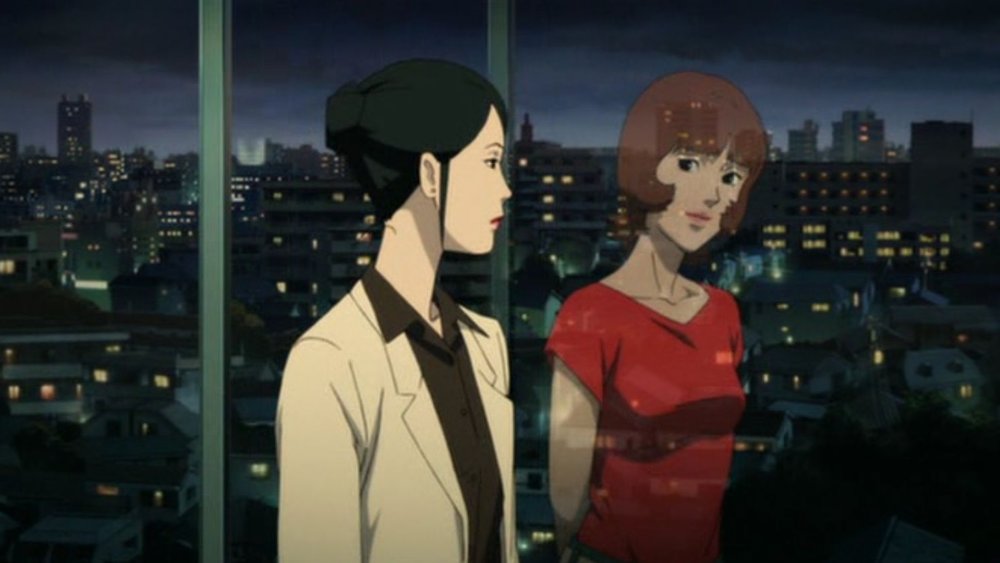
Two of the main characters, Atsuki Chiba and Paprika, are slowly shown to be connected until it's revealed that they are the same person. Paprika is thus shown to be Atsuki's projection of herself on the dreams. This is played with later in the film as we see both Atsuki and Paprika interacting with each other and other people within the final dream.

Fresh Eyes: Paprika (2006)
Figure 2, Refleection.
One of the reasons the film was created using animation over live-action with CGI is because some scenes would be easier to show through animation. This is in part due to expense as well as technological limitations. One scene that demonstrates this is when Atsuki is revealed inside Paprika as while the scene may have been possible in CGI it would have been more challenging and expensive to do.

Figure 3, Paprika is Atsuka
The film warps and shift the images seen frequently throughout the film. This leads to fluid transitions between being awake and dreaming as well as showing the slow way fantasies can be found more interesting by people than the reality they live in. During one dream in particular, a parade of inanimate objects are shown. In an interview Satoshi Kon said that 'for viewers to identify with this dream, I chose a parade which makes one think automatically of other common dreams and unconscious states. There are very old characters like objects that are discarded by people today or religious symbols that people have forgotten.'(Pais, 2006). This dream formed a shared dream in which the dreamers are dragged into the dream and lose all sense of themselves outside of the dream world. The mass of objects in the dream 'works to one of the film’s themes, namely that our fantasies, including those opened up by the Internet, are pulling us away from the material world and, perhaps, more dangerously from one another.' (Dargis, 2007). This is further shown in how one of the entrances to the dream world is through a virtual bar one of the main characters logs into. He gets brought into the bar as if he were truly there and interacts with everything as if it were real.

Image result for paprika 2006 detective
Figure 4, Losing Reality.
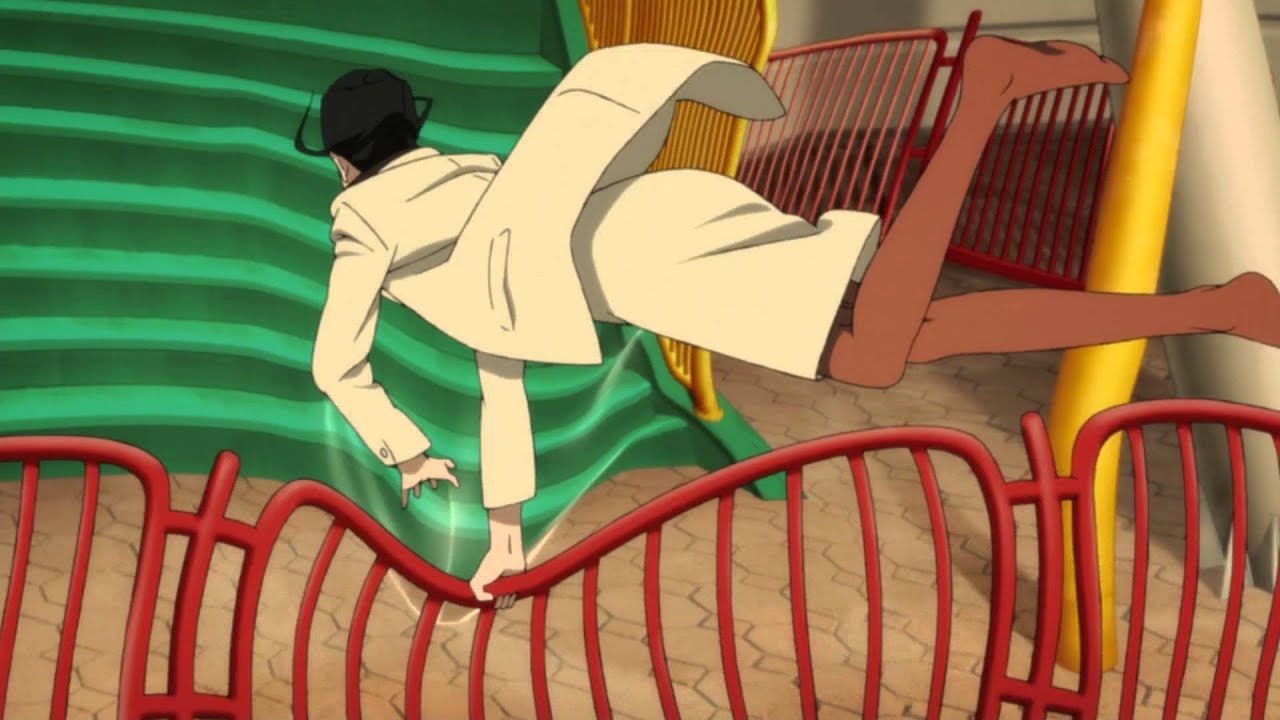
Reality in the film slowly declines as the film progresses. This begins when Chiba hops over a fence at an amusement park only for it to warp and reveal she was about to hop over a balcony instead (shown in Figure 4). This is the first instance the audience encounters that shows reality shifting in the same way dreams would. This is in the film said to be due tot he amount of time spend within the DC Mini and that the longer spent in there the easier it is to slip into a dream without realising even when awake.

Bibliography:

- Dargis, N, (2007), [Online], http://www.nytimes.com/2007/05/25/movies/25papr.html (Accessed on: 05/02/18)

- Pais, J, (2006), [Online], http://screenanarchy.com/2006/10/paprika-interview-with-satoshi-kon.html (Accessed on 05/02/18)

Illustration List:

- Figure 1, Movie Poster, http://www.imdb.com/title/tt0851578/

- Figure 2, Reflections, http://www.talkfilmsociety.com/columns/fresh-eyes-paprika-2006

- Figure 3, Paprika is Atsuka, http://www.interrogatingideologywithachainsaw.com/2014/06/paprika-2006.html

- Figure 4, Losing Reality, https://cinemaoftheabstract.blogspot.co.uk/2016/06/paprika-2006.html

Saturday, 3 February 2018

Film Review | Mary and Max

Mary and Max (2009) is an Australian film written and directed by Adam Elliot. The film follows the story of a girl named Mary and a man named Max. The film was created using claymation and explores themes of loneliness as well as mental health. 

Image result for mary and max
Fig 1, Movie Poster


The film first introduces the audience to Mary, a lonely girl whose parents ignore her for the most part and who is bullied at school. She lives in Australia and wants a friend so to achieve that ends up sending a letter to a random name in the phone book, thus Max is introduced. Max is a 44 year old man living in New York, he also is lonely and lacks friends and so when he receives Mary's letter he replies. This begins an odd friendship between the two.

The use of claymation allowed for a distinct line to be drawn in the colours used throughout the film. New York, and by extension Max, is depicted in black and white while Australia and Mary are seen in browns. The only exception to this is the colour red which can be seen in both places, primarily through the gifts and letters the characters send to each other. This allowed the use of 'red as a device to make all those little objects that Mary and Max send each other more potent, more significant.' (Buckmaster, 2009). Examples of this can be seen in Figures 2 and 3. Figure 2 shows Max and his red pompom while figure 3 shows Mary and her red hair clip and ring.

Image result for mary and max
Fig. 2, Max
Image result for mary and max
Fig. 3, Mary.
The film discusses themes such as loneliness and mental illness. This is through a few different ways. One way is that there is a focus on Mary not having friends and thus being lonely, this is furthered when the audience is aware of her father remaining in his garage without talking to her when he isn't working and her mother being an alcoholic. This leaves Mary lonely as she has nobody she can talk to both at home and at school. Loneliness is also shown through Max as shown through his lack of friends and his having an imaginary friend. Another theme explored through the film is mental illness. This is seen in various ways throughout the film such as Max's Asperger's and Mary's later depression. Throughout the film it's shown that 'Everyone in the film is damaged; a few are suicidal and don't make it, so there's a sense of life's traumas.' (Byrnes, 2009). This allows for the audience to see characters that aren't perfect and haven't got perfect lives, they're more mundane and have troubles that anyone could face.


Bibliography:

- Buckmaster, L (2009), Interview with Adam Elliot, writer/director/designer of Mary and Max [Online] https://blogs.crikey.com.au/cinetology/2009/04/10/q-a-with-mary-and-max-writerdirectordesigner-adam-elliot/ (Accessed: 02/02/18)

- Byrnes, P, (2009), Review - Mary And Max, http://www.smh.com.au/news/entertainment/film/film-reviews/mary-and-max/2009/04/09/1239222976896.html (Accessed on: 03/02/18)

Illustration List:

- Figure 1, Movie Poster, http://mstamp176.blogspot.co.uk/2016/02/review-mary-and-max.html

- Figure 2, Max, https://nwfilm.org/films/mary-and-max/

- Figure 3, Mary, http://www.imdb.com/title/tt0978762/mediaviewer/rm1527398144

Saturday, 16 December 2017

Film Reviews | All Links

Film Reviews:


'What We Do in the Shadows' - Documentary/Mockumentary


The film 'What We Do in the Shadows', directed by Jemaine Clement and Taika Waititi, is a Mockumentary created in New Zealand. The film follows a group of vampires as they go about their lives. It's filmed in a way that parodies the conventions of documentary making however with entirely fictional subjects it is a mockumentary.

The film is shot as a series of short sketches that are stitched together to create the whole film. The scenes fit together to tell a comedic account of a group of vampires that live in a flat together and the struggles they face in their daily lives. Examples of this include things such as not being allowed to enter buildings without being invited first as well as more trivial things such as their clothes being several years out of fashion.

The film is shot as if there is a film crew there that the characters frequently refer to, talk to and interact with as well as with scenes that are almost interview style moments with each of the vampires. The film crew have no lines but are always present and occasionally shown on camera, such as in the scene where the vampires run into werewolves on a full moon and some of the crew gets eaten. The film is shot as if through hand held camera's and the combination of that and the use of purely diegetic sounds create a sense of realism which is juxtaposed by the ridiculousness of the vampires themselves.

Illustration List:

Fig, 1. Movie Poster. Found at: https://monsterzeronj.wordpress.com/2015/07/23/bare-bones-pitch-perfect-2-what-we-do-in-the-shadows-and-sharknado-3/

Friday, 15 December 2017

Exploitation and Mad Max Fury Road

The film 'Mad Max: Fury Road' (2015), directed by George Miller, is an example of an exploitation film. 'Mad Max: Fury Road' is the fourth Mad Max film to be created. The first falls into the category of B-movie while the more recent ones moves away from d-movies. 'Mad Max: Fury Road' is the most recent sequel to the film.


The film's plot is simple, a group of characters drive from point A to B and back again, however the way the story is told is what makes it more interesting than that. The film uses exploitation in it as it exploits violence and vehicles consistently throughout the film. This is something that's followed through all the mad max films as they have a focus on cars and bikes as well as on gruesome violence. Examples of the exploitation of vehicles can be seen in the vehicles the war boys use and in the war rig driven by Furiosa. Another key example would be the scene where we are first given a look at the war boys, specifically Nux. This is because they are given orders to chase the war rig and thus go to collect their steering wheels from a shrine to the V8, praying to it as they do. This glorifies a car engine to the status of a deity.

Violence is also exploited within the film with scene of war boys killing each other and one of a mans mouth being ripped off. Body horror and body modifications are seen throughout the film in many forms beginning with Max being chained and branded. Other examples include the war boys many modifications as well as Immortan Joe himself having what amounts to an oxygen mask on at all times as well as a clear chest piece used to cover his mutations..


Wednesday, 18 October 2017

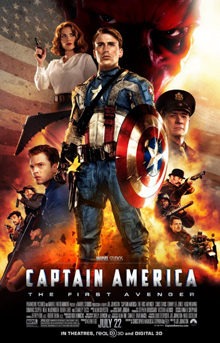
The Three Act Structure in Captain America: The First Avenger

The Three Act structure is a structure found in many films. It's a way to tell the beginning middle and end of a film and to divide them into smaller parts. The film Captain America: The First Avenger follows the three act structure.


Firstly in act 1 we have the exposition, in Captain America: The First Avenger this is when we meet Steve, a weak and fairly scrawny guy, and we see him getting beat up but not giving in until his friend comes along to help him. We then follow him and find that Steve wants to join the war efforts but isn't allowed to due to his many health issues. Next we have the incident, this is when Steve meets Dr Erskine and is told he can join the army provided he takes part in an experiment. In plot point 1, after Steve is injected with Erskine's serum, Steve chases down a spy that is trying to steal the serum. This is where Steve first meets someone working for the main antagonist.

In act 2 Steve faces obstacles such as the way he is entertainment for the masses instead of being the soldier he aimed to be, this is something he becomes aware of when he has to provide entertainment for a regiment of soldiers and they mock him. It is then that he finds out his friend, Bucky, is missing as he is meant to be in that regiment. This leads to the first culmination as that is where Steve stops being entertainment and instead goes and saves Bucky, finding the antagonist, Red-skull's, plans. The mid point is then when Steve and Bucky return and begin to rally a group for a mission to stop Red-skulls plans. The next plot point, Plot point 2, is when Steve discovers that there is a bomb in the plane and its headed for the centre of the city.

This leads into the climax which occurs at the very end of Act 2, near the beginning of Act 3. This is when Steve realises the choice he must make and crashes the plane into the ocean, thus saving everyone.

In Act 3 the twist and the resolution are closely ties as the twist is when we find out that Steve is actually still alive, preserved in the ice, and the resolution is then when they are de-icing him.

Wednesday, 4 October 2017

The Hero's Journey in Thor


The Hero's Journey is a set of events that unfurl in a film that can be a basis of the story. The Hero's Journey is something that can be found in many movies, one such movie is 'Thor'. This is what will be explored here.

In Thor the ordinary world is Asgard as this is where Thor grew up, it's his home and all he knows. In this world Thor is a prince, soon to be King, and respected. He expects people to listen and is confident, reckless and bold. His Call to Adventure comes when the frost giants invade during his coronation, later revealed to be due to his brother Loki, and he must go to stop them from stealing from Asgard. Instead of taking the advice given to him by his father, he insists that it is a deceleration of war, even as others tell him that it was likely just a small factions decision. For this Call to Adventure, Thor needs to act as a King should and not be reckless however he Refuses the Call by deciding to attack all the frost giants for the perceived war deceleration. This decision is reckless and one that could cost him and the friends that joined him their lives. It is further refused when Loki manages to broker peace with the King of the frost giants only for Thor to once again attack when provoked.

For Thor, Supernatural Aid came in the form of his father Odin arriving to stop a war from breaking out between Thor and his Friends and the Frost Giants. Odin establishes his role as mentor here as he reprimands Thor for his reckless actions and banishes him to humanity to teach him a lesson in humility. This leaves Thor in The Belly of The Beast as he now finds himself mortal and stuck in a land he has no idea how to live in. He has reached the lowest point for him, having been banished from his home at the hands of his disappointed father, and he must figure out how to make things get right from here.

The Road of Trials happens while Thor tries to adapt to life on Earth. He is confronted with things and experiences he's never had to face before, as well as customs he doesn't understand. In Thor he Meets The Goddess just before he faces the Road of Trials, as he meets Jane after she hits him with her van. Jane then helps Thor learn how to better navigate Earth and they begin to develop feeling for each other as they do. Thor's quest to become worthy of lifting his hammer is thus delayed as he spends more time with Jane, this is where Woman as the Temptress comes into play.

Thor's Atonement with the Father occurs when he realises his father was right and that he had been too reckless, this is after Thor attempts to break into the Government controlled site around his hammer in an attempt to retrieve it only to be foiled by being unable to lift the hammer. Loki is the instigator as he mentions Odin being dead, even though he isn't, to Thor who begins to rethink his actions. Apotheosis happens when Thor decides to sacrifice himself to save earth, this is because Thor has finally learnt the humility and understanding Odin sought to teach him and has reaffirmed his status as a God. This leaves him with The Ultimate Boon as he is able to lift Mjolnir, his hammer, once again.

Thor then faces the Refusal of the Return as he doesn't want to leave Jane, whom he loves, but he must as Asgard is in danger and he is the only one able to save it. Ultimately he Crosses the Return Threshold and goes back to Asgard to stop Loki from destroying things, only this time he is less reckless about his plan. Thor, now Master of Two Worlds, destroys the bridge connecting Asgard to Earth as it is the only way to stop Loki, even as it leaves him unable to return to Jane. He has made a choice that is better for his land than himself.

Thor, now a wise ruler capable of leading Asgard, has learnt what he needed to and is now a better leader and person for it, he has earned the Freedom to Live.

Tuesday, 16 May 2017

Film Review - Picnic at Hanging Rock

Picnic at Hanging Rock is a 1975 film directed by Peter Weir. The film is about a group of school girls as they go on a school trip to have a picnic at hanging rock. A few of the girls as well as one of the teachers go missing and only one is later found. The film was based on a book written by Joan Leslie in 1967.

Figure 1 - Movie Poster
In the novel the story was shown 'as fiction but hinted that it might be based on fact.' (Ebert, 1998). This presentation led to people believing the events had happened and as such 'old newspapers and other records were searched without success for reports of disappearing schoolgirls.' (Ebert, 1998). This could be due to people not having experienced stories presented as fact before or conversely due to people desiring to find an answer to the mystery left in the story.

Figure 2- The Rock
Theories of what happened to the girls ranges from UFO's to kidnappings, though there is no real answer. Some theorise that the rock itself may have taken the girls, which is supported by the way 'Russell Boyd's camera examines the rock in lush and intimate detail -- its snakes and lizards, its birds and flowers -- certain shots seem to suggest faces in the rock, as if the visitors are being watched.' (Ebert, 1998). This is particularly noticeable when people are climbing amongst the rock, first with the girls and later with the two boys that look for them. Another factor supporting this theory is that the girls themselves seem helpless to stop climbing the rock. The four of them keep climbing as if drawn to the rock, even when the know the should be heading back. The exception to this is Edith, the seemingly youngest of the group, who frequently requests they go back and doesn't want to climb any higher. This is then brought to a head as 'Edith, the young and geeky member of the group, watches her companions shuffle off like robots, as if they're being led by a supernatural force.' (Buckmaster, 2014). Edith is then seen fleeing and the girls are never seen again.

The music in the film creates an interesting atmosphere around the rock. This is due to the low, humming, buzz the rock gives off when close to it. The sound itself starts of almost subtly, with less menace as the girls climb. However when the boys try to find them the sound of the rock is loud and insistent, pressing down on the senses and screaming danger, This is all in stark contrast to the more cheery panpipe music that plays throughout the rest of the film. As scenes are shown of the students and teacher travelling to the rock, and of the rock itself, 'Music, some of it classical, played by panpipes, is an unsettling contrast.' (Ebert, 1998).

Bibliography:

Buckmaster, L, (2014), Picnic at Hanging Rock: Rewatching classic Australian films - https://www.theguardian.com/culture/australia-culture-blog/2014/jan/23/picnic-hanging-rock-rewatching-australian-films

Ebert, R, (1998), Picnic at Hanging Rock - http://www.rogerebert.com/reviews/great-movie-picnic-at-hanging-rock-1975

Image List:

Figure 1 - Movie Poster - http://www.impawards.com/1975/posters/picnic_at_hanging_rock_ver1.jpg

Figure 2 - The Rock - https://neithernevernor.files.wordpress.com/2014/10/picnichangingrock.png?w=676&h=411

Sunday, 5 March 2017

Film Review - Duel

Duel is a 1971 film directed by Steven Spielberg. It follows a driver, named David Mann, as he travels along a mostly empty and desolate road, all the while being terrorised by the driver of a large truck.

Image 1, Movie Poster

Duel is a film told with only one human character, David Mann, who is pitted against a truck with an unseen driver. David Mann expresses most things through actions rather than words, not saying very much. 'Mr. Weaver is David Mann, the film's only real character, and he's given a few internal monologues that only awkwardly express Mann's anxiety.' (Maslin, 1983). The anxiety felt by Mann is also shown through his face as he reacts to the truck.

Image 2, Mann's anxiety
Mann's adversary in this is a huge truck he overtakes on a long deserted road. The choices made for both Mann's car and the Truck show the difference in the drivers. Mann's car is small and dwarfed by the Truck chasing him. 'Presented with a line-up of vehicles, Spielberg opted for a Peterbilt gasoline tanker truck, partly due to its strangely human aspect' (Freer, 2000). This then meant that the Truck became a character of it's own, as we are never once shown the driver and we are given to recognise the humanistic aspects in the Truck itself.

Image 3, The Truck
The camera angles used by Spielburg also enhance the idea of the Truck being much larger than Mann's car as well as the idea of the Truck itself being a character. 'Spielberg emphasised the pace and scale of the vehicles by placing the camera low to the road.' (Freer, 2000). The camera being often kept below the vehicles was a way of emphasising the size of them, this was also done by having the camera show both the Truck and the car in the shot. This allowed the viewer to see the stark difference in size between the two vehicles.

Images:

Image 1, Movie Poster - http://img.moviepostershop.com/duel-movie-poster-1971-1010378306.jpg

Image 2, Mann's anxiety - http://fr.web.img2.acsta.net/r_1280_720/medias/nmedia/18/68/45/56/19028244.jpg

Image 3, The Truck - http://vignette2.wikia.nocookie.net/villains/images/a/af/Duel1971_truck.png/revision/latest?cb=20120608013215

Bibliography:

Maslin, J, 'SPIELBERG'S 'DUEL,' FOUR-WHEEL COMBAT, 1983 - http://www.nytimes.com/movie/review?res=9804EFD81138F936A25757C0A965948260

Freer, I, EMPIRE ESSAY: Duel Review, 2000 - http://www.empireonline.com/movies/empire-essay-duel/review/

Saturday, 4 March 2017

Film Review - The Birds

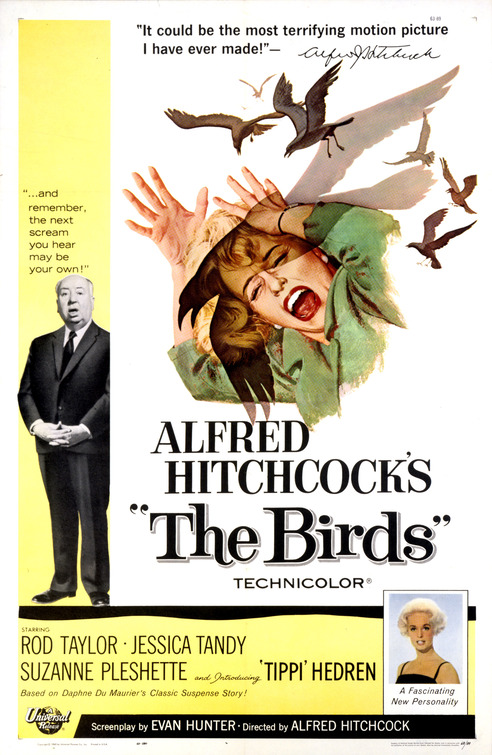
The Birds is a 1963 film directed by Alfred Hitchcock. The film follows Melanie Daniels who, after meeting a lawyer that pulls a prank on her, follows him to a small town called Bodega Bay in order to prank him back, its only after she arrives that the small town begins to get attacked by birds.


Image 1, Movie Poster

Melanie Daniels is shown to be a confident woman, who comes from a rich background and is used to getting what she wants. She begins the film as someone who enjoys pulling pranks on people and as someone with a great deal of confidence in herself and her ability to attract males. She uses a pair of lovebirds in her prank, bringing them into bodega bay to give to the lawyer and then not long after the birds began to attack as if 'The entire bird world, chagrined to be the pawn in a devious woman's game, gets its revenge.' (Bidisha, 2010). Then as the film progresses Hitchcock puts her through increasingly violent situations that by the end of the film leave her a shell of her former self.

Image 2, Melanie
The reasons for the birds attacking is never explained, leaving both the viewers and the characters with no clue why the birds attack. One proposed reason for the birds attack is that of  'the hysterical woman who links the attacks to Daniels' arrival ("I think you're the cause of all of this"). This implies that the birds are a manifestation of sex, some galvanic hormonal storm that whisks sleepy Bodega Bay into a great communal lather.' (Brooks, 2012). Another theory being that of 'an eruption of rage. The film's first act, after all, is an uncomfortable buildup of tension (both sexual and social), an ongoing joust of loaded glances and teasing evasions. Its characters are so guarded, so gamey, so disconnected from their own emotions, that something's got to give.' (Brooks, 2012). As such the moment the birds first start attacking is the moment things begin to fall apart for Melanie as she is then placed in the midst of bird attack after bird attack until the moment she breaks.

Image 3, Melanie attacked by birds.
The film has no music, using only diegetic sounds such as the birds themselves flapping and cawing. 'Instead of relying on Herrmann’s music to heighten and embellish the drama and the horror, he uses Herrmann’s sense of dynamics to program in a constant gushing of strangely affecting diegetic sound.' (Scovell, 2014). The lack of a musical soundtrack meant the diegetic sounds of the film were much more apparent and easier to hear, as such 'the absence of a score renders the horror more immediate: Hitch's long-time composer Bernard Herrmann fashioned an eerie soundtrack from caws, strident screeches and rustling wings.' (Sooke, 1963).

Images:

Image 1, Movie Poster - http://www.impawards.com/1963/posters/birds.jpg

Image 2, Melanie - https://c1.staticflickr.com/3/2500/3979907148_3f5e40d156.jpg

Image 3, Melanie attacked by birds - https://s3.amazonaws.com/filmlinc/assets/uploads/comment/film_comment_blog/0925.png

Bibliography:

Bidisha, What's wrong with Hitchcock's Women, 2010 - https://www.theguardian.com/film/2010/oct/21/alfred-hitchcock-women-psycho-the-birds-bidisha

Brooks, X, My favourite Hitchcock: The Birds, 2012 - https://www.theguardian.com/film/filmblog/2012/jul/31/my-favourite-hitchcock-the-birds

Scovell, A, Sounds of the Birds, (2014) - https://celluloidwickerman.com/2014/09/04/sounds-of-the-birds-1963-alfred-hitchcock/

Sooke, A, The Birds, review: Disturbing, (1963) - http://www.telegraph.co.uk/culture/film/filmreviews/11334674/The-Birds-review-disturbing.html

Film Review - Psycho

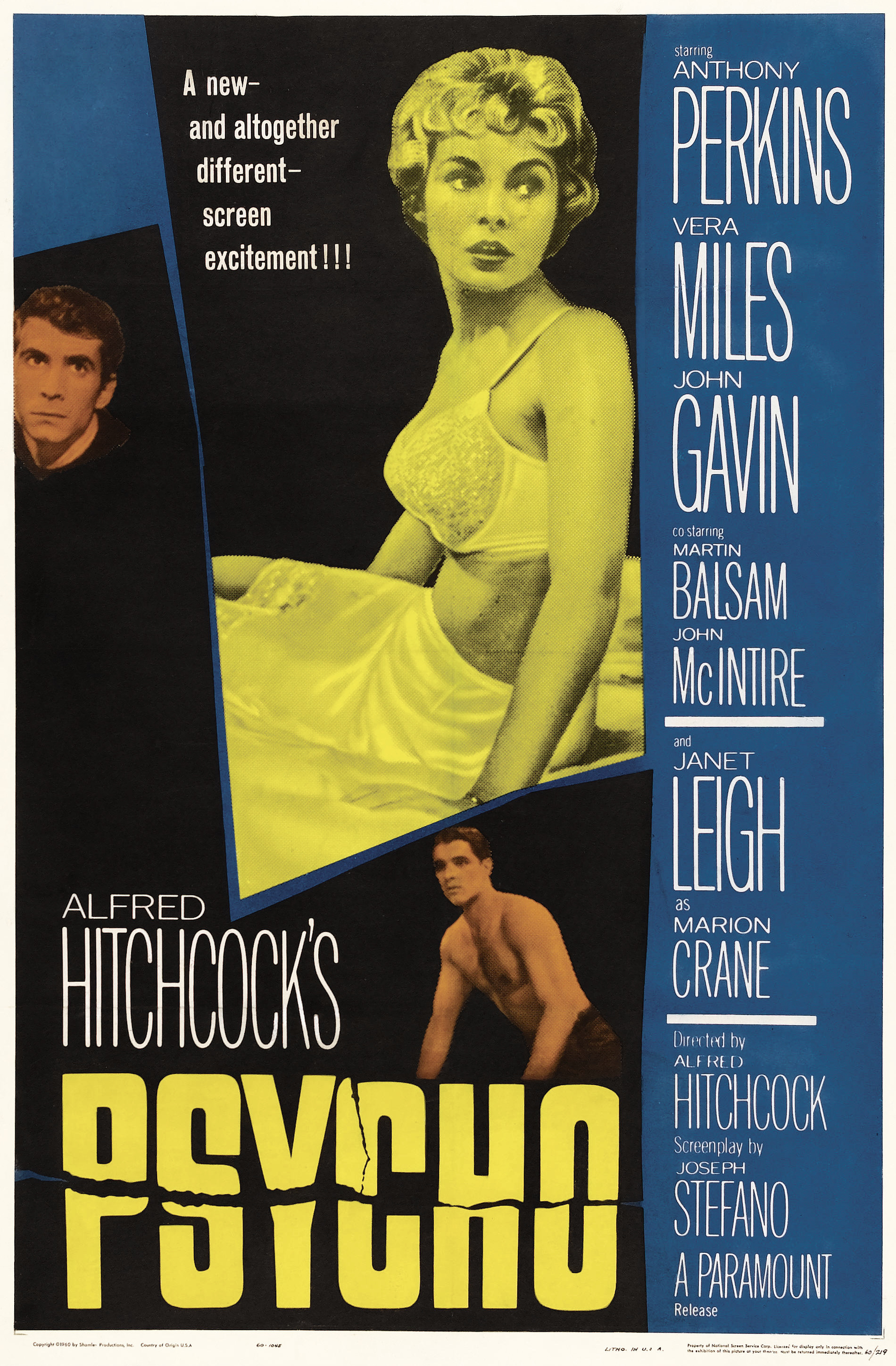
Psycho is a film created in 1960 by director Alfred Hitchcock. The story follows a woman as she steals money from a wealthy customer at her work and leaves with the intent on going to her boyfriend. She finds herself staying in the Bates Hotel and murdered there in an unexpected turn of events.

Figure 1, Movie Poster


In Psycho Hitchcock plays with the way we watch films as we would usually expect to see the main character at the start and follow them until the end. In psycho however we are introduced to Marion at the beginning and thus led to believe that we will follow her throughout the entire film. On Marions journey she stops at the Bates Motel and this is when we meet Norman Bates. The way Norman is introduced, through a conversation with Marion after she overhears Norman's mother shouting at him, is key in helping the audience recognise him as important. 'Hitchcock's care with the scenes and dialog persuades us that Norman and Marion will be players for the rest of the film.' (Ebert, 1998). This is then abruptly challenged when Hitchcock kills her off not long after and only a third of the way through the film, leaving the audience confused as to who they should be watching. That's when we return to Norman Bates, a character the audience immediately recognises as the next protagonist, or perhaps in fact the true protagonist, of the film. 'Hitchcock is insidiously substituting protagonists. Marion is dead, but now (not consciously but in a deeper place) we identify with Norman--not because we could stab someone, but because, if we did, we would be consumed by fear and guilt, as he is.' (Ebert, 1998).

Figure 2, The parlour
Birds are used in the film as a prop to show the conflict in Norman as they loom over him in the parlour at the back of the motel. The stuffed birds there seem to be 'poised to swoop down and capture them as prey.' (Ebert, 1998). The birds are there and give the impression of something watching, perhaps implying the watching gaze of Normans mother. 'The creatures are everywhere in Psycho, from the aerial shots, to Marion's surname, to the town where the action begins (Phoenix), to the hideous taxidermy looming on Norman's walls, and even his world-view.' (Monahan, 2015).

Figure 3, Marion's eye
The conflict in Norman is what comes to a head two thirds of the way through the film in the form of both Marion and the detectives murder. The shower scene, which showed no stabbing and very little blood, was a shock and remained unnerving as the camera panned slowly into Marions eye. This scene however 'is very nearly matched for shock value by the later dispatching of Detective Arbogast as he explores the motel on Marion's trail.' (Monohan, 2015). The detective is shown to be murdered however the assailant is hardly seen. The camera, which had been following the detective up the stairs, is placed in a birds-eye-view of the top of the stairs while a figure is shown darting through to push the detective back down.

Normans conflict is later explained in the last third of the film, as the psychologist is called in to detail what's wrong with him. Hitchcock's decision to have the psychologist explain the film is one that many have brought into question citing that he 'marred the ending of a masterpiece with a sequence that is grotesquely out of place.' (Ebert, 1998) as it is 'an anticlimax taken almost to the point of parody.' (Ebert, 1998). However there is some merit to the explanation as it can have 'a profound place in the schema: the doctor can diagnose and explain a phenomenon that he’s seemingly powerless to foresee or cure. There’s no redemptive ending, no love story that conquers all, no promise that such ills won’t be repeated.' (Brody, 2012).


Image List:

Figure 1, Movie Posterhttp://www.bernardherrmann.org/wp-content/uploads/2011/07/psycho-4.jpg

Figure 2, The parlour - http://nofilmschool.com/sites/default/files/styles/article_wide/public/psycho_3.jpg?itok=7hdpUTP5

Figure 3, Marion's eye - http://www.leninimports.com/psycho_photo_11_new.jpg

Bibliography:
Brody, Richard, 'The Greatness of "psycho"' (2012) - http://www.newyorker.com/culture/richard-brody/the-greatness-of-psycho


Ebert, Roger, Psycho (1998) - http://www.rogerebert.com/reviews/great-movie-psycho-1960


Monahan, Mark, Psycho, Review (2015) - http://www.telegraph.co.uk/culture/film/filmreviews/11025424/Psycho-review.html


Monday, 30 January 2017

Film Review - Rope

The 1948 film Rope was directed by Alfred Hitchcock. It was based on a play of the same name written in 1929. The film follows two men who murder a friend of theirs and then proceed to host a party, all while the dead body is hidden in a trunk in the room. As the party progresses and the guests remain unaware of their friends death, Phillip is shown slowly falling to his guilt while Brandon remains unnervingly cheerful about his success until inevitably Rupert figures out their secret.

Figure 1 - Movie Poster

The film is shot without any cuts which adds to the feeling of it being a play. The limitations of the time meant that there was no way to film in one solid chunk, as such 'Hitchcock's camera was loaded with 10-minute reels, and had to duck behind an actor's back, or a piece of furniture, to "invisibly" cut from one piece of film to the next.' (Hutchinson, 2012). This meant the room often felt small to the viewer as they were shoehorned behind various objects and people.

It also adds suspense in that the viewer is often left unable to see characters or hear dialogue clearly, leaving them unable to gauge the characters they can't see. The use of the continuous shot allows for the passing of time to be shown which allowed the film to keep it's suspense. As Ebert said 'The play depended, for its effect, on the fact that it was one continuous series of actions. Once the characters have entered the room, there can’t be any jumps in time, or the suspense will be lost. The audience must know that the body is always right there in the trunk.' (Ebert, 1984).

The emphasis on the trunk is further enhanced by Hitchcock keeping the trunk in the front of a multitude of shots, as seen in figure 2. One shot that uses the trunk to it's advantage in this way is when the maid is clearing the dinner away as seen in figure 3. 'While the guests are discussing something of no great moment just off- screen, the camera, catlike, stares at the chest as the maid gets ready to put some books back into it, unaware, of course, that the chest is already fully occupied.' (Canby, 1984).


Figure 2, The Trunk

Figure 3, Maid putting the books away
The way the camera moves adds to the tension in the room as it makes the place feel smaller and everyone in it feel more cramped together. This in turn makes it feel as though 'They're trapped, and so is the audience. Perversely, this cinematic experiment replicates the theatrical experience: Rope feels "live", which means that at any minute one of the actors could do something unexpected, such as fluff their lines, or heaven forbid, open the trunk.' (Hutchinson, 2012). As such the viewer is constantly waiting to see not to see if they Phillip and Brandon will get found out but rather when they will.


Image List:

Figure 1, Movie Poster - https://thejar.hitchcock.zone/files/gallery/org/338.jpg

Figure 2, The Trunk - http://www.tasteofcinema.com/wp-content/uploads/2013/11/rope.jpg

Figure 3, Maid putting the books away - https://theseventhart.files.wordpress.com/2010/04/rope.jpg

Bibliography:

Canby, V, 1984, 'Rope': A Stunt to Behold (Online) - http://www.nytimes.com/library/film/060384hitch-rope-reflection.html (accessed on 30/01/2017)

Ebert, R, 1984, Rope (Online) - http://www.rogerebert.com/reviews/rope-1948 (accessed on 30/01/2017)

Hutchinson, P, 2012, My favourite Hitchock: Rope (Online) - https://www.theguardian.com/film/filmblog/2012/jul/27/my-favourite-hitchcock-rope (accessed on 30/01/2017)

Monday, 19 December 2016

Film Review - Black Narcissus

Fig 1. Movie Poster
Black Narcissus (1947) directed by Michael Powell and Emeric Pressburger is a film that focuses on loneliness and solitude. The film follows a group of nuns as they set up a school and hospital on top of a mountain. The top of the mountain is a remote place, leaving the nuns in isolation for much of their time.

The films use of colour works with its story in that there are more natural colours used at the beginning, then as the nuns feel the effects of isolation more colours are brought in. One such colour is red used to light scenes where conflict is shown, both internal conflict and external, particularly around Sister Ruth. This is shown slowly shown through colour, 'A copper pink light is thrown onto the walls through grills and windows and the scene of Sister Ruth applying red lipstick holding a vivid red compact, is spellbinding' (Howells, 2011). The red that is used appear 'feverish and is as effective and foreboding as Nicholas Roeg's "Don't Look Now"' (Mirasol, 2010).

Fig 2, Sister Ruth applies lipstick
The isolation in the film is shown to have an effect on the characters the more time they spend in it. At the beginning of the film the nuns are shown as normal, devout and kind but as the film progresses the isolation affects them all. Throughout the film it is shown that 'their inner turmoil is exacerbated by extreme conditions and isolation.' (Mirasol, 2010). Sister Ruth is particularly affected by the isolation and as such 'conceives an erotomaniacal obsession for Dean, and her final appearance in the film, gaunt and wraithlike, is still one of the scariest moments'. (Bradshaw, 2005).

Bibliography:

Bradshaw, Peter, 2005 "Black Narcissus" - https://www.theguardian.com/theguardian/2005/aug/05/3

Howells, Michael, 2011 "Behind the Mask: Production design in Black Narcissus" - http://guru.bafta.org/behind-mask-production-design-black-narcissus
Mirasol, Michael, 2010 "Black Narcissus," which electrified Scorsese - http://www.rogerebert.com/far-flung-correspondents/black-narcissus-which-electrified-scorsese

Images:

Figure 1 - http://www.kennelco.com/wp-content/uploads/2016/07/Black-Narcissus.jpg

Figure 2 - https://s-media-cache-ak0.pinimg.com/originals/63/de/5a/63de5a6a65b34dbce2ebd4f43208873e.jpg

Monday, 5 December 2016

Film Review - Edward Scissorhands

Fig 1. Movie Poster


Tim Burton's 1990 film Edward Scissorhands is a story 'told gently, subtly and with infinite sympathy for an outsider who charms the locals but then inadvertently arouses their baser instincts.' (Lee, 2014). The story is that of the character Edward who is brought down from his castle to the quiet suburb by the Avon lady, Peggy.

Initially the suburbs community is welcoming and curious about Edward, seeing him as something new and exciting. Edward is revered to a celebrity status by the community until he is involved in a crime and their idolism turns sour causing the people to 'turn on him, eventually driving him out of the community. Meanwhile his wistful and impossible attraction to Kim (Winona Ryder), the Avon lady's teenage daughter, adds another layer of tension.' (Dawes, 1990).

Fig 2. The suburban town in contrast with the castle.


The idea of a community that wants to be different while ultimately all buying the same things is apparent in the film through the design of both the suburban environment and the costume designs of the community. The movie shows this through 'an entirely artificial world, where a haunting gothic castle crouches on a mountaintop high above a storybook suburb, a goofy sitcom neighbourhood where all of the houses are shades of pastels and all of the inhabitants seem to be emotional clones of the Jetsons.' (Ebert, 1990). Edward himself is completely different in all this, living in a greyscale almost Victorian castle on top of a hill and dressed all in black leather, leading him to be the character that's most individual to himself thus making him completely ostracised by everyone else.

Fig 3. Edward and Kim


Bibliography:


Dawes, Amy (1990) Film Review: Tim Burton’s ‘Edward Scissorhands’ - http://variety.com/1990/film/reviews/edward-scissorhands-1200428433/

Ebert, Roger (1990) Edward Scissorhands - http://www.rogerebert.com/reviews/edward-scissorhands-1990

Lee, Marc (2014) Edward Scissorhands, review: 'a true fairytale' - http://www.telegraph.co.uk/culture/film/filmreviews/11298442/Edward-Scissorhands-review-a-true-fairytale.html

Images:

Figure 1 - http://www.manizalescity.co/img/actividades/Manizales-Cine-Eduardo-Manos-de-Tijeras2.jpg

Figure 2 - https://filmgrab.files.wordpress.com/2012/10/1214.jpg

Figure 3 - http://www.hippoquotes.com/img/edward-scissorhands-old-kim-quotes/enhanced-buzz-28880-1395200323-8.jpg

Tuesday, 1 November 2016

Film Review - La Belle et la Bête

La Belle et La Bête (1946) is a French film adaptation of the story 'the beauty and the beast' directed by Jean Cocteau. The story is that of a beautiful lady that volunteers herself to die in place of her father when he steals a rose from the beasts garden. The beast however keeps her in his castle and they begin to get to know each other better.

Figure 1: Movie Poster


Throughout the film the beast is shown to be both very human and undeniably a beast. As said by Geoffrey Macnab, 'As played by Marais, the Beast comes across as a dapper, renaissance version of a werewolf in a Universal horror film. One moment, he'll be on his haunches drinking water from Beauty's hands, but the next he'll be growling out some surprisingly chivalrous dialogue.' (Macnab, 2014). He speaks as a human would, walks on two legs and carries Belle to her bed when she faints but he is also shown to drink water in the same was as an animal and to hunt as an animal would. Belle is shown to shift from the fear she held when he roamed the hallways after a kill, smoke rising from his fingertips (as seen in figure 2), to a more empathic view, walking with him in the gardens (as seen in figure 3) while talking to him more as a human than a beast. The film ends up 'giving us a Beast who is lonely like a man and misunderstood like an animal' (Ebert, 1999).

Figure 2: Smoke rising after the Beast killed
Figure 3: Belle and the Beast walking together
The look and style of the film was based firmly on the concept art created by Christian Bérard, who drew on black paper with chalks (see figure 4). This is shown through many of the scenes, where the darkness seems to envelop the screen with only the lights and the figures being illuminated in the rooms. Christian Bérard also worked on the designs for the costumes, 'the costumes, too, by Christian Berard and Escoffier, are exquisite affairs, glittering and imaginative, lacking only the glow of color, as we say.' (Crowther, 1947). The costumes themselves fit in the scenes beautifully, both magical to look at and yet entirely believable as clothing.

Figure 4: Concept Art


Bibliography:

Ebert, R. 1999 - The Beauty and The Beast:
http://www.rogerebert.com/reviews/great-movie-beauty-and-the-beast-1946 (Accessed: 01/11/2016)

Crowther, B. 1947 - Film Review:
http://www.nytimes.com/movie/review?res=9B03EFD71E3EEE3BBC4C51DFB467838C659EDE
Macnab, G. 2014 - La Belle Et La Bete: Film review:
http://www.independent.co.uk/arts-entertainment/films/reviews/la-belle-et-la-bete-film-review-cocteaus-forties-fantasy-is-still-a-thing-of-real-beauty-9035506.html (Accessed: 01/11/2016)

Images:

Figure 1:
https://s-media-cache-ak0.pinimg.com/originals/30/f1/9c/30f19c4fe6ff1cc0e415b7b943532e8d.jpg

Figure 2:
https://locotigrero.files.wordpress.com/2011/09/la-belle-et-la-bete-beast-smoking-paws.jpg?w=300&h=225

Figure 3:
https://i.ytimg.com/vi/f21S-DH81_M/maxresdefault.jpg

Figure 4:
http://theredlist.com/media/database/muses/icon/iconic_men/1940/christian_berard/02_christian_berard-theredlist.jpg

Monday, 24 October 2016

Film Review - 2001: A Space Odyssey

2001: A Space Odyssey was directed by Stanley Kubrick and released in 1968. The film has a confusing plot that leaves a lot up for interpretation, leading there to be many different idea's on the films story. One perspective of this is that 'The plot is not so much of structure but rather of events or moments in time that are united by the appearance of a large black monolith.' (Haflidason, 1968).

Figure 1: Movie Poster

The use of music in 2001: A Space Odyssey is interesting as there are scenes where there is nothing but music and motion with nobody talking at all and also scenes where there is no sound at all, just the emptiness of space. This has prompted people to write that 'One of the more crucial elements of 2001 is the lack of sound  that dominates the film, which is true to that there would be no sound in space (no atmosphere means no medium for sound transmission).' (Scott, 2009). The music used was classical music that wasn't created for the film. The use of a score designer for the film would have attempted 'to underline the action - to give us emotional clues. The music chosen by Kubrick exists outside the action.' (Ebert, 1997). This use of music encourages the viewer to observe the scenes as they happen instead of needing to respond to them the same way you would if the music was there to evoke a response.

Figure 2: Spacecrafts

The camera shots used in the film also create a distance from the events as they keep the characters in the middle to back of the screen (see fig 3) and rarely move into the foreground. This creates a sense of distance as it is difficult to see the faces of the characters which makes it feel impersonal. There are few exceptions to this, one of the most prominent being the use of a close-up shot on the character of Dave as he is shutting down the computer HAL (see fig 4). The shots show the lack of emotion on Dave's face as he destroys a creation he had previously said was like another crew member. The scene evokes a sadness and sympathy that feels wrong given it's directed at a machine, a computer with dubious ability to think or feel independently of it's programming.

Figure 3

Figure 4

Bibliography:

Roger Ebert, 1997: 2001: A Space Odessey Review:
http://www.rogerebert.com/reviews/great-movie-2001-a-space-odyssey-1968

Almar Haflidason, 1968: 2001: A Space Odessey Review:
http://www.bbc.co.uk/films/2000/09/18/2001_review.shtml

Ridley Scott, 2009: 2001: A Space Odessey Review:
http://www.dailygalaxy.com/my_weblog/2009/07/ridley-scott-science-fiction-is-dead.html

Images

Figure 1:
https://blogger.googleusercontent.com/img/b/R29vZ2xl/AVvXsEg9GAgI6Xhbdz6AJg_lk6-PnX_OUcCOgZhBjEm6PwMypHtshhLv6gjMbUS6gJIP6iedeRn79W57UQzOmqdsv8g9hwVWONvrbK6YH4cr9QR9tDfZIvcT0gP2sF_MDGCQecMfcj0h4WRQ1Pg/s1600/2001+A+Space+Odyssey+(1968)+Space+Station+One+by+Robert+McCall.jpg

Figure 2:
https://fogsmoviereviews.files.wordpress.com/2011/09/20110925-011821.jpg

Figure 3:
http://irenebrination.typepad.com/.a/6a00e55290e7c4883301bb07b7f1d9970d-800wi

Figure 4:
https://www.sfsymphony.org/getmedia/ee280956-c54f-41a5-b62d-a39c6b98e4e0/2001-Space-Odyssey?width=583&height=335&ext=.jpg

Sunday, 23 October 2016

Film Review - King Kong

King Kong was released in 1933 and was directed by Ernest B. Shoedsack and Merian C. Cooper. The film tells the story of a filmmaker, Carl Denham, who hires a girl, Ann Darrow, and takes her to a mysterious Island for the filming of his movie. While the story tells the tale of a Beast it is done in such a way that the beast is not seen as inherently evil, instead seen more 'as a creature that in its own way wants to do the right thing' (Ebert, 2002).

Figure 1: Movie Poster

The film being made in the 1930's is evident in a lot of the events that transpire, one that springs to mind being the depiction of the natives in the island scenes (see fig 2). Ebert writes that 'viewers will shift uneasily in their seats during the stereotyping of the islanders in a scene where a bride is to be sacrificed to Kong' (Ebert, 2002). The film has a clear underlying reference to slavery, as shown through the capture and further exhibition of Kong (see fig 3). The character of Ann Darrow is also a project of it's time as she is depicted as a damsel in distress for the majority of the movie and being saved by one of the men that previously insulted her.

Figure 2: The Islanders

Figure 3: King Kong Captured

The film itself is very influential, featuring special effects that were new for their time as well as a soundtrack featuring music specifically for each character and scene. The music is used to enhance the emotions for each scene, using suspenseful music to build suspense and calmer music to let the audience know when things are calmer. The films use of 'A gripping and fitting musical score and some impressive sound effects rate with the scenery and mechanism in providing "Kong" with its technical excellence' (Bigelow, 1933).

Bibliography:

Ebert, R. (2002) King Kong Review:
http://www.rogerebert.com/reviews/great-movie-king-kong-1933

Bigelow, J. (1933) King Kong Review:
http://variety.com/1933/film/reviews/king-kong-2-1200410783/

Images:

Figure 1:
https://s-media-cache-ak0.pinimg.com/originals/76/d1/10/76d110fc47a86432a70c7e9795b8cb96.jpg

Figure 2:
https://blogger.googleusercontent.com/img/b/R29vZ2xl/AVvXsEhYpk6TALcU6ck6s8jAX5bXRPPFECLSotBbDv5ZFw-u1KXnZ5negfGpdhy-OObtZ-2ueE28HwWmeu87cv5AVwzF7vkSkM-oM3mhHMByhJQmdcACpdPLyu3HlUDskDam_uTOA5OPcHXIPps/s1600/KingKong_059Pyxurz.jpg

Figure 3:
http://manapop.com/wp-content/uploads/2015/07/kong-on-stage.jpg