Film Reviews

Alexis Cornwell - BA (Hons) Computer Animation Arts, UCA Rochester
Showing posts with label Premise. Show all posts
Showing posts with label Premise. Show all posts
Friday, 11 May 2018

Premise | Magazine Article

Bibliography:
https://www.animationcareerreview.com/articles/concept-artist-career-profile
https://www.cgspectrum.edu.au/blog/what-it-is-like-to-be-a-professional-concept-artist
http://creativeskillset.org/job_roles/3072_concept_artist
https://careertrend.com/facts-5618539-job-description-concept-artist.html
Thursday, 10 May 2018
Premise | Reflective Statement
As a project I found premise to be challenging as I initially struggled to figure out what to do for the project. I found that I didn't spend as much time on the project as I should have which led to me not having as much done to a standard I would have wanted. I found that working in the Sumi-e style forced me to be more simplistic in my drawings instead of working in a more realistic way. I found this to be somewhat challenging but enjoyable nonetheless. I think that I need to re-look at the way the second act of the story functions as I need to make the parents role clearer in the overall story. This would then allow for the audience to understand the story better. Another thing I need to go back through and re-work are the camera shots as they could be more interesting through more use of close-ups. Something I am going to work on is how I balance my time as I didn't spend as much on premise as I needed to and this caused more problems that could have been avoided if I had managed my time more efficiently.


Thursday, 3 May 2018
Premise | Influence Map Updates
 |
| Influences |
This is a newer version of my influence map that explores the idea's for the building and the beginnings of the bridge structures.
Premise | Updates
 |
| Environment Ideas 1 |
 |
| Environment Ideas 2 |
 |
| Props for Hikoboshi |
 |
| Tree Design 1 |
 |
| Tree Design 2 |
 |
| Tree Design 3 |
 |
| Tree's in Seasons |
 |
| Hikoboshi Clothing |

Wednesday, 11 April 2018
Premise | Character Concepts
The two characters in the story I am telling are Orihime, a weaver, and Hikoboshi, a cow-herder.
For the Hair I looked into the styles that were worn in Japan during and around the Edo Period. This allowed me to narrow the hair down to some idea's I felt fit well. I feel that F1 and M1 in the above image are the one's I will choose to further as they feel the most fitting.
For Orihime and Hikoboshi's faces I wanted to get an idea of what they would look like. On Orihime's sheet I like 1 and 8 the most. From Hikoboshi's sheet I like 5 and 7. I think I will further Orihime 8 and Hikoboshi 5.
For Orihime's outfit it didn't need to be something that allowed as much movement and as such I wanted to create something that reflected more her weaving as well as leave traces of the stories origins - the constellations. For outfits I plan to have Hikoboshi's outfit to resemble something that could be worn while herding animals, allowing freedom of movement, while still fitting in the time the tale is set as well as matching with Orihime's outfit to some degree.
 |
| Initial Look at Hairstyles |
 |
| First few Sketches |
 |
| Orihime's face - Initial Ideas |
 |
| Hikoboshi's Face - Initial Ideas |
 |
| Orihime's Outfit - Initial Idea's |

Thursday, 22 February 2018
Tuesday, 6 February 2018
Film Review | Paprika
Paprika (2006) is a Japanese film directed by Satoshi Kon. It was based on Yasutaka Tsutsui's novel from 1993.
 |
| Fig. 1, Movie Poster |
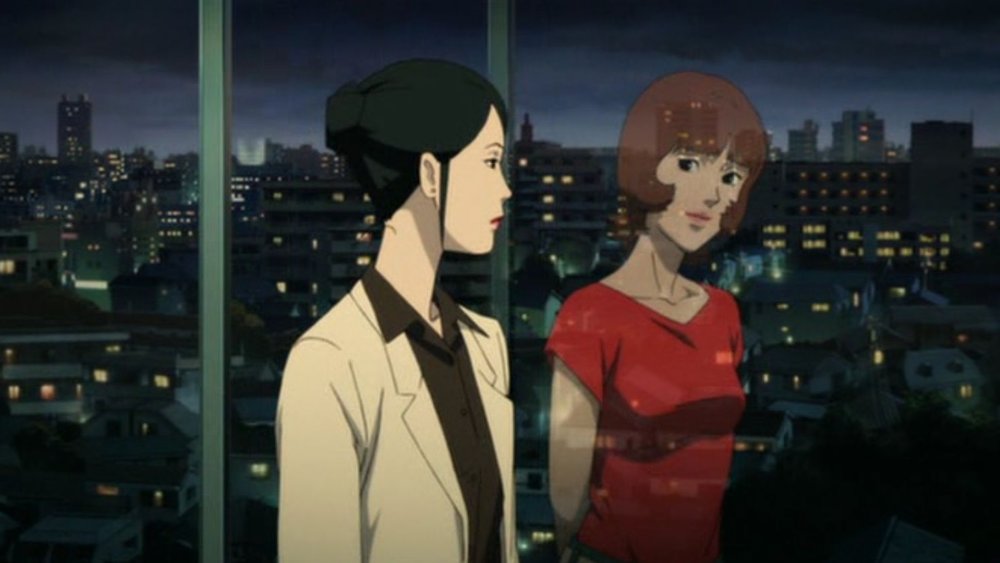
Two of the main characters, Atsuki Chiba and Paprika, are slowly shown to be connected until it's revealed that they are the same person. Paprika is thus shown to be Atsuki's projection of herself on the dreams. This is played with later in the film as we see both Atsuki and Paprika interacting with each other and other people within the final dream.
One of the reasons the film was created using animation over live-action with CGI is because some scenes would be easier to show through animation. This is in part due to expense as well as technological limitations. One scene that demonstrates this is when Atsuki is revealed inside Paprika as while the scene may have been possible in CGI it would have been more challenging and expensive to do.
The film warps and shift the images seen frequently throughout the film. This leads to fluid transitions between being awake and dreaming as well as showing the slow way fantasies can be found more interesting by people than the reality they live in. During one dream in particular, a parade of inanimate objects are shown. In an interview Satoshi Kon said that 'for viewers to identify with this dream, I chose a parade which makes one think automatically of other common dreams and unconscious states. There are very old characters like objects that are discarded by people today or religious symbols that people have forgotten.'(Pais, 2006). This dream formed a shared dream in which the dreamers are dragged into the dream and lose all sense of themselves outside of the dream world. The mass of objects in the dream 'works to one of the film’s themes, namely that our fantasies, including those opened up by the Internet, are pulling us away from the material world and, perhaps, more dangerously from one another.' (Dargis, 2007). This is further shown in how one of the entrances to the dream world is through a virtual bar one of the main characters logs into. He gets brought into the bar as if he were truly there and interacts with everything as if it were real.
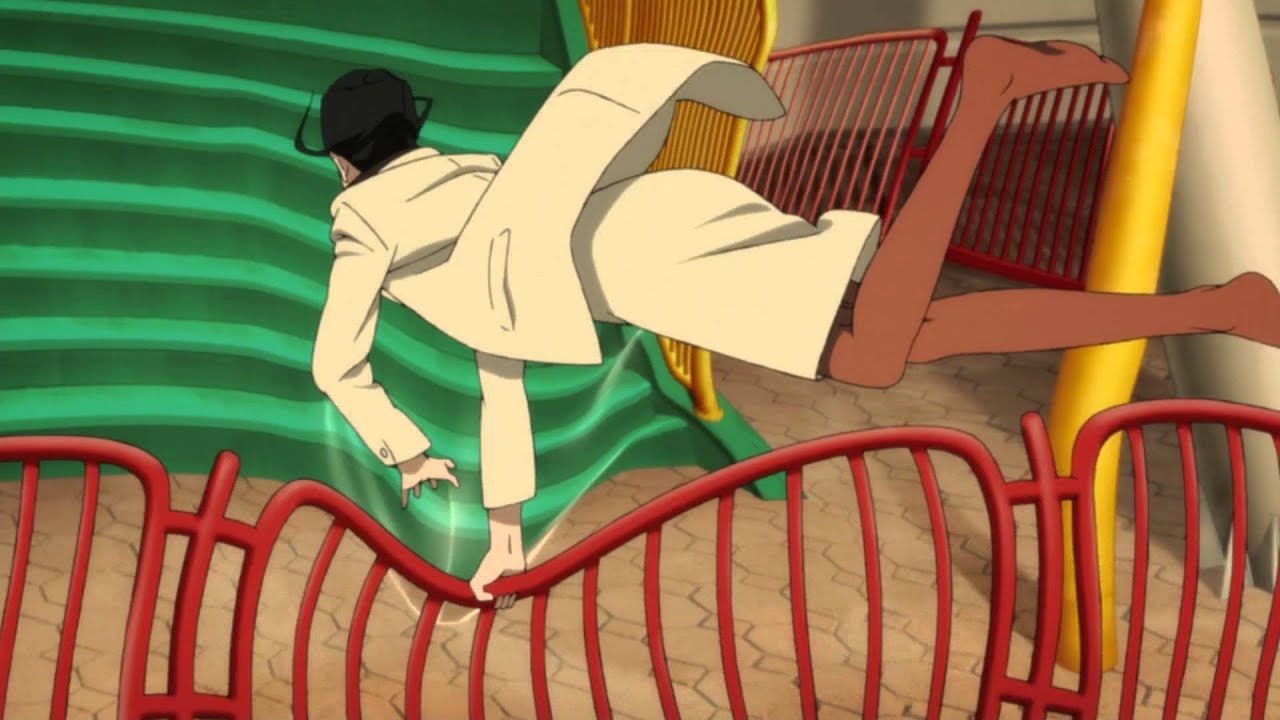
Reality in the film slowly declines as the film progresses. This begins when Chiba hops over a fence at an amusement park only for it to warp and reveal she was about to hop over a balcony instead (shown in Figure 4). This is the first instance the audience encounters that shows reality shifting in the same way dreams would. This is in the film said to be due tot he amount of time spend within the DC Mini and that the longer spent in there the easier it is to slip into a dream without realising even when awake.
Bibliography:
- Dargis, N, (2007), [Online], http://www.nytimes.com/2007/05/25/movies/25papr.html (Accessed on: 05/02/18)
- Pais, J, (2006), [Online], http://screenanarchy.com/2006/10/paprika-interview-with-satoshi-kon.html (Accessed on 05/02/18)
Illustration List:
- Figure 1, Movie Poster, http://www.imdb.com/title/tt0851578/
- Figure 2, Reflections, http://www.talkfilmsociety.com/columns/fresh-eyes-paprika-2006
- Figure 3, Paprika is Atsuka, http://www.interrogatingideologywithachainsaw.com/2014/06/paprika-2006.html
 |
| Figure 2, Refleection. |
 |
| Figure 3, Paprika is Atsuka |
 |
| Figure 4, Losing Reality. |
Bibliography:
- Dargis, N, (2007), [Online], http://www.nytimes.com/2007/05/25/movies/25papr.html (Accessed on: 05/02/18)
- Pais, J, (2006), [Online], http://screenanarchy.com/2006/10/paprika-interview-with-satoshi-kon.html (Accessed on 05/02/18)
Illustration List:
- Figure 1, Movie Poster, http://www.imdb.com/title/tt0851578/
- Figure 2, Reflections, http://www.talkfilmsociety.com/columns/fresh-eyes-paprika-2006
- Figure 3, Paprika is Atsuka, http://www.interrogatingideologywithachainsaw.com/2014/06/paprika-2006.html
- Figure 4, Losing Reality, https://cinemaoftheabstract.blogspot.co.uk/2016/06/paprika-2006.html
Tuesday, 30 January 2018
Tuesday, 23 January 2018
Premise Idea's
The story/idea behind my premise project is that of constellations. I want to show the stories behind the constellations.

Some initial ideas for my premise project include the use of an object to tell the story. Some idea's i have for that object include Zoetropes, Praxinoscopes and a camera/photographs.
Subscribe to:
Posts (Atom)